


























Views
Downloads
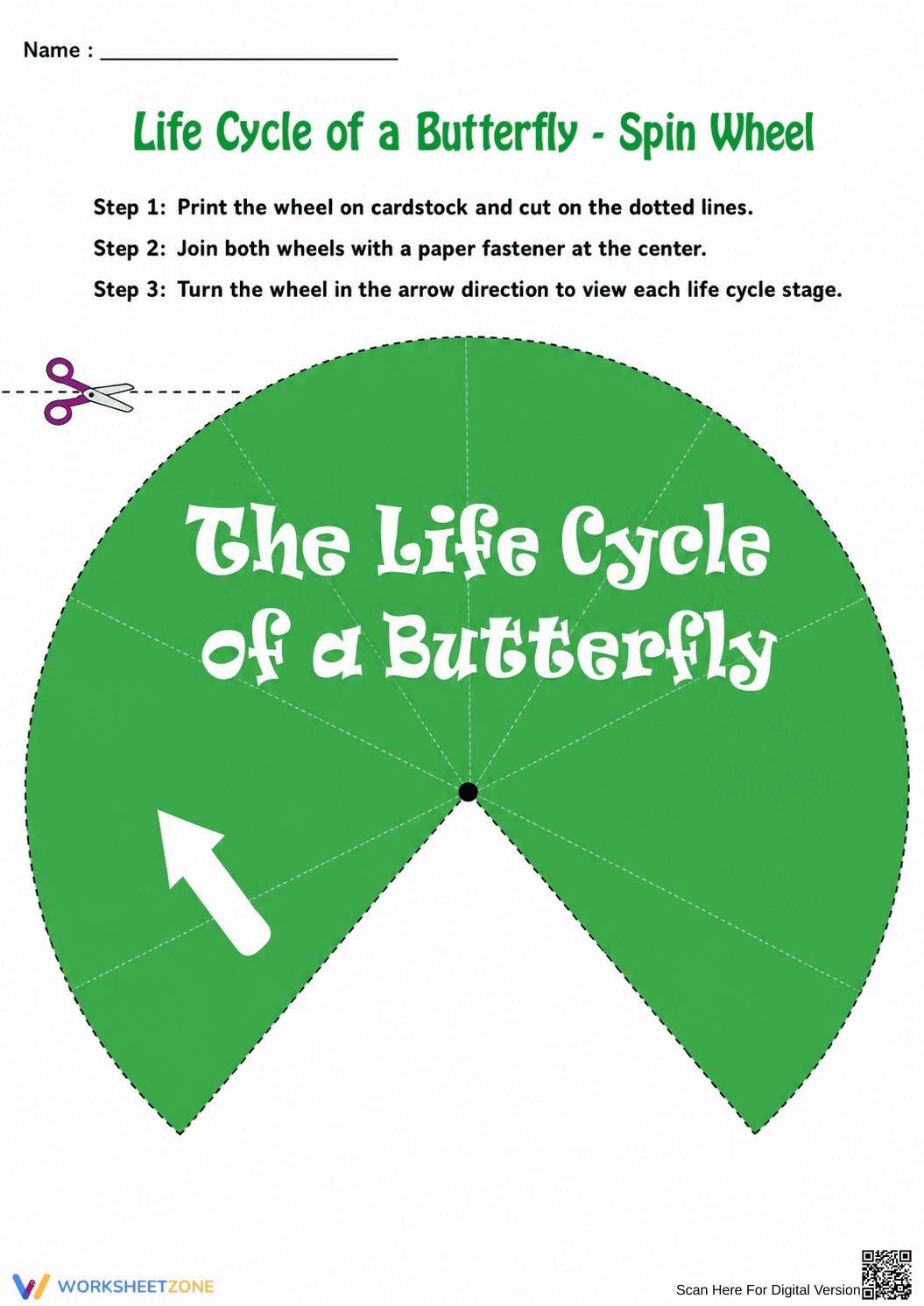

Printable Butterfly Life Cycle Spin Wheel | Grade 3-5
Paste this activity's link or code into your existing LMS (Google Classroom, Canvas, Teams, Schoology, Moodle, etc.).
Students can open and work on the activity right away, with no student login required.
You'll still be able to track student progress and results from your teacher account.
This interactive life cycle of a butterfly spin wheel helps students visualize metamorphosis through a hands-on craft. By assembling this 2-page model, learners explore biological stages from egg to adult. It reinforces scientific concepts while providing a tactile experience that improves retention of living things topics. This resource simplifies complex biological transitions into a manageable, engaging classroom activity.
At a Glance
- Grade: 3-5 · Subject: Science
- Standard:
3-LS1-1— Develop models to describe that organisms have unique and diverse life cycles- Skill Focus: Metamorphosis stages
- Format: 2 pages · 1 interactive model · No answer key needed · PDF
- Best For: Interactive science journals and hands-on centers
- Time: 15–20 minutes
What's Inside
This resource includes two printable pages: a viewing cover and a base wheel with illustrations of the butterfly life cycle. It features assembly instructions, scissor-cut lines, and a central fastener guide. The layout is optimized for standard paper or cardstock to ensure durability during student interaction. Students will identify the four primary stages: egg, larva, pupa, and adult butterfly.
Zero-Prep Workflow
- Print (1 minute): Select the pages and print on cardstock for best results and durability.
- Distribute (1 minute): Hand out sheets along with scissors and one paper fastener per student.
- Review (15 minutes): Students cut, assemble, and rotate the wheel to explain each stage to a partner.
This activity requires minimal teacher preparation time, making it an ideal choice for emergency sub plans or last-minute science rotations.
Standards Alignment
This resource is primary aligned to `3-LS1-1`: "Develop models to describe that organisms have unique and diverse life cycles but all have in common birth, growth, reproduction, and death." It also supports `4-LS1-1` by illustrating how structures function to support growth and survival. Both standard codes can be copied directly into lesson plans, IEP goals, or district curriculum mapping tools.
How to Use It
Use this spin wheel as a culminating activity after a direct instruction lesson on metamorphosis. It serves as an excellent formative assessment tool; as students spin the wheel, ask them to describe the transition between the larva and pupa stages. This interactive model is best used during the "Elaborate" phase of a 5E science lesson to solidify understanding. Expect completion in 20 minutes.
Who It's For
This activity is designed for Grade 3-5 students exploring life science. It is particularly effective for kinesthetic learners and English Language Learners (ELLs) who benefit from visual and tactile support. It pairs naturally with a butterfly habitat observation or a non-fiction reading passage about the monarch butterfly's journey.
The use of interactive models in science is supported by research into multi-sensory learning. According to the RAND AIRS 2024 report, hands-on modeling of biological processes, like the butterfly life cycle, increases engagement and recall in elementary science. By mapping the 3-LS1-1 standard to a spin wheel, students move from passive observation to active construction of knowledge. This aligns with Fisher & Frey (2014) regarding scaffolds that help students visualize temporal changes. This 2-page printable interactive provides the structure for Grade 3-5 learners to master metamorphosis while meeting national standards for life science. It is a proven tool for classroom-ready instruction that minimizes teacher burden while maximizing student moments during the study of living things. This resource ensures that the 15-minute instructional block is utilized effectively for high-impact learning.


